White Label P2P Crypto Exchange
Launch a branded P2P crypto exchange where buyers and sellers can discover offers, select trading terms and complete peer-to-peer digital asset transactions through a structured marketplace.HashCash provides P2P exchange infrastructure that can be configured around your marketplace model, supported assets, payment options, user controls and exchange requirements.
P2P Marketplace Built Around Buyer-Seller Trading
A P2P exchange is fundamentally a marketplace for direct buyer-seller transactions. Instead of presenting only a conventional order-entry screen, the platform can organize available offers around the terms that matter to the trade: asset, price, amount, payment method and transaction status.
HashCash’s P2P exchange infrastructure can be configured to support a marketplace model in which users can buy, sell and trade digital assets with other users while selecting preferred trading terms and payment methods.
Key marketplace functions include:
- Buy & Sell Offers — Users can access available offers for buying or selling supported digital assets.
- Offer Details — Each offer can present relevant trading information such as asset, price, amount and payment method.
- Payment Method Selection — Buyers and sellers can work with the multiple payment methods supported by the marketplace.
- Order Management — Users can monitor active P2P orders and their current status.
- Balance Visibility — Users can view relevant fiat and digital-asset balances within their trading environment.
- Transaction History — Completed and previous activity can be reviewed through the user's transaction records.
- Marketplace Administration — Operators can monitor P2P activity through the administrative environment.
Buyer & Seller Trading Workflow
A P2P exchange connects buyers and sellers through a structured marketplace. A buyer can review available offers, compare the terms provided by sellers, and initiate a trade that matches the required asset, amount, price, and supported payment method. The seller then receives the trade request while the platform tracks the transaction through its configured order and settlement stages.
The exact payment, verification, asset-holding, and settlement process can vary according to the exchange model and the mechanisms implemented for the deployment. This allows the P2P marketplace workflow to be aligned with the operator's trading and settlement requirements.
Seller Creates Offer
Buyer Selects Offer
Trade Initiated
Payment Step
Payment/Trade Confirmation
Configured Settlement
Trade Recorded
Payment Methods & Fiat / Crypto Support
Payment flexibility is central to a P2P marketplace because buyers and sellers need a way to complete the payment leg of a trade according to the terms of the selected offer. HashCash's P2P exchange infrastructure can be configured around multiple payment methods and supported fiat currencies, allowing operators to structure marketplace workflows according to their target users, markets, and trading requirements.
Where supported by the deployment, users can select from the payment methods available for a particular offer before proceeding with the trade. The platform can also present the relevant fiat and digital-asset information associated with the transaction.
Trading Dashboard & Order Management
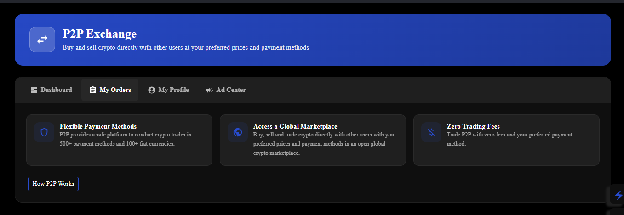
A dedicated trading dashboard gives users a centralized view of their P2P activity, bringing relevant trading information, balances, orders, and transaction records into a single interface. Users can monitor their active trading activity while accessing key information such as:
- Real-Time Market Information — View current cryptocurrency prices and relevant trading information.
- Open Orders — Keep track of active orders and their current status.
- Order & Transaction History — Review previous trading activity and completed transactions.
- Fiat & Cryptocurrency Balances — View available balances across supported fiat and digital assets.
- Asset Trends — Access historical price or asset-trend information where supported.
- Trading Workflow — Move from marketplace activity into the relevant trading and order-management interface.
Admin Panel & Marketplace Controls
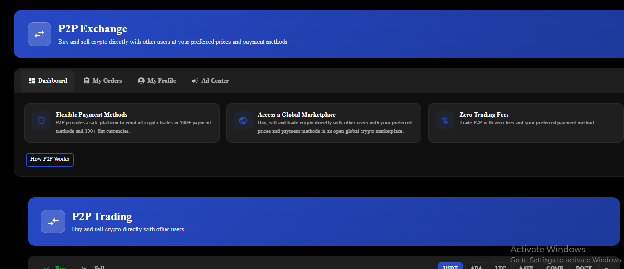
A P2P marketplace requires strong operator-side visibility across users, transactions, payment activity, and asset movements. The administrative environment brings these activities together so authorized operators can monitor marketplace operations and review relevant transaction information from a centralized interface. Key administrative capabilities include:
- Buy & Sell Transaction Monitoring — Review P2P transactions and their current status.
- User & Document Information — Access relevant user and verification information within the administrative environment.
- Transaction Details — Review transaction identifiers, timestamps, and other associated records.
- Sender & Receiver Information — View counterparty details where applicable to the transaction.
- Payment-Order Status — Track the status of payment-related orders associated with P2P activity.
- Digital-Asset Balance Monitoring — Monitor relevant cryptocurrency balances within the exchange environment.
- Pending Transactions — Identify transactions that remain pending and require further processing or review.
- Administrative Controls — Perform available administrative actions according to the permissions and configuration of the deployment.
Security, KYC/AML & Transaction Oversight
A P2P exchange connects multiple counterparties while managing trading activity, payment-related information, and digital-asset transactions. Its infrastructure therefore needs appropriate controls for account access, user verification, transaction monitoring, and asset management. HashCash's exchange infrastructure can support security and operational controls including:
- Two-Factor Authentication — Add an additional layer of protection to user account access.
- KYC & User Verification — Support user verification and associated document-management workflows.
- Geography-Specific Verification — Configure KYC/AML processes according to applicable market and deployment requirements.
- Wallet & Transaction Controls — Manage digital-asset wallets and associated transaction activity through the exchange infrastructure.
- Transaction Monitoring — Track transaction activity and identify pending transactions requiring processing or review.
- Infrastructure Security — Apply security controls across the broader exchange architecture, including protected application, database, network, and wallet environments.
The broader exchange architecture incorporates security measures such as multi-signature cold wallets, encrypted hot wallets, SegWit, BIP-32, database encryption, firewall and DDoS protection, and two-factor authentication.
How a P2P Trade Works
Choose the Market
Select the digital asset and relevant P2P market.
Review Available Offers
Compare price, amount, payment method and supported trade terms.
Select a Counterparty
Choose an available buyer or seller offer.
Open the Trade
Create or accept the P2P transaction according to the platform workflow.
Complete the Payment Step
The buyer completes the agreed payment method while the trade remains in its applicable transaction state.
Confirm & Settle
Payment confirmation and the configured asset-release or settlement workflow are completed.
Record the Trade
Completed activity remains available through transaction and trade-history functions.
Why HashCash for a White Label P2P Crypto Exchange?
HashCash combines the P2P trading experience with the infrastructure needed to operate a complete digital-asset exchange.