Crypto Mining Pool
Launch a branded mining pool with infrastructure to connect miners, manage workers, track submitted shares, calculate rewards and operate pool activity from a centralized platform.What Is Crypto Mining Pool Software?
Crypto mining pool software is the infrastructure used to operate a pool where multiple miners contribute computational work toward a proof-of-work network. The pool coordinates work distribution, receives shares, validates contribution and records activity for reward calculation.
A mining pool generally sits between participating miners and the relevant blockchain infrastructure. It provides work, receives submitted shares, validates them and records each worker's contribution. When a valid block is found, the pool applies its configured accounting and payout rules. HashCash positions their mining pool as part of a broader digital-asset infrastructure environment, connecting relevant wallet, asset, transaction, API, reporting and administrative services where required.
How Does a Cryptocurrency Mining Pool Work?
Miner Connection
Compatible mining hardware or software connects to the configured pool endpoint using the supported mining protocol.
Job Distribution
The pool supplies mining work based on the selected proof-of-work network and pool configuration.
Share Submission
Miners submit shares representing completed portions of computational work. Shares allow the pool to measure contribution even when an individual share does not produce a block.
Share Validation
The pool validates submitted work against the relevant mining rules and records qualifying shares.
Block Detection
When the pool finds a valid network block, the block and its associated reward enter the pool's reward workflow.
Reward Calculation
The configured payout model determines how the available reward is attributed to participating miners.
Payout & Records
Eligible rewards move through the configured payout process while pool activity remains available for dashboards, transactions and reporting.
Core Features of the Mining Pool Platform
- Worker Accounts — Organize participating miners and connected workers.
- Worker Identification — Associate submitted shares and activity with the relevant worker.
- Worker Status — Show active and inactive worker activity where supported.
- Worker Performance — Monitor worker hashrate and contribution data.
- Pool Endpoints — Provide configured connection points for compatible mining hardware.
- Stratum Connectivity — Connect compatible miners through supported Stratum infrastructure.
- Algorithm Configuration — Structure the pool around supported proof-of-work algorithms.
- Network Integration — Connect pool services with required blockchain infrastructure.
- Share Tracking — Record valid submitted shares and associate them with workers.
- Contribution Accounting — Calculate contribution using the selected pool rules.
- Reward Calculation — Apply the configured payout logic.
- Payout Records — Maintain records of reward allocations and completed payouts.
- Pool Hashrate — Monitor aggregate computational activity.
- Worker Hashrate — Review individual worker performance.
- Share Activity — Track accepted share activity.
- Block Activity — Monitor blocks discovered through the pool.
- Pool Configuration — Manage supported networks, algorithms and operating parameters.
- Reward Configuration — Define payout and reward rules for the deployment.
- User Management — Review participating miners and account information.
- Reporting — Connect pool activity with operational reporting.
- Access Control — Restrict sensitive administration functions.
Mining Pool Reward & Payout Management
Reward distribution is central to a pool because miners need to understand how their contribution translates into pool rewards.
Common payout models provided by HashCash include Pay-Per-Share (PPS), Pay-Per-Last-N-Shares (PPLNS), proportional approaches and hybrid structures. Each model changes how contribution, pool risk and payout timing are handled.
Payout models
PPS
Calculates rewards around valid submitted shares according to the pool's configured PPS rules.
PPLNS
Uses a defined window of recent qualifying shares for reward calculation.
Proportional
Calculates a miner's share according to contribution within the applicable round.
Hybrid
Combines characteristics of different payout approaches when required.
Mining Pool Dashboard
A mining pool dashboard turns raw pool activity into information miners and operators can understand quickly.
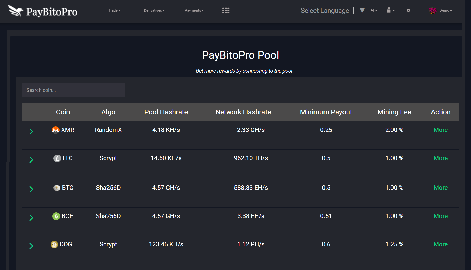
- Pool Hashrate — Show aggregate computational activity.
- Active Workers — Display workers currently submitting activity.
- Shares — Show accepted share activity and contribution data.
- Blocks — Display blocks found and their status where supported.
- Rewards — Show recorded or estimated rewards according to the configured model.
- Payouts — Provide visibility into payout records and status.
Mining Pool Admin Panel
The operator side needs more than a public statistics page. HashCash's administration layer gives the pool owner control over miners, workers, supported networks, reward settings, payouts, transactions and reporting.
HashCash's existing exchange architecture provides user management, transaction management, asset management, wallet management, reporting, liquidity management, risk management, API management and modular access control. These capabilities provide a logical connected-infrastructure layer for the mining pool.
Wallet & Payout Infrastructure
Mining rewards need a defined asset destination and an auditable transaction path. HashCash can connect the mining pool with the wallet and transaction layers responsible for supported digital assets, allowing eligible miners to be associated with supported payout addresses or account balances while calculated rewards remain visible for processing.
Through the configured payout workflow, HashCash can support the movement of eligible rewards while maintaining the associated transaction records. This provides a structured path from reward calculation to payout and transaction reconciliation, giving operators the records needed for ongoing review and operational management.
Mining Pool Reporting & Analytics
Operators need historical information to understand pool activity, reward distribution and miner participation.
Mining Pool Security & Operational Controls
A mining pool exposes infrastructure to external connections, so secure network design, access control, monitoring and operational separation are important parts of the deployment.
Secure Miner Connectivity
Protect communication between miners and the pool according to the security requirements and configuration of the deployment.
Network Segmentation
Keep public-facing mining connectivity separate from sensitive administrative and operational services to reduce unnecessary exposure.
Access Control
Apply controlled permissions to operator functions, configuration changes, and other administrative activities.
Activity Monitoring
Monitor worker connections, traffic patterns, and unusual activity to help identify operational or security-related anomalies.
Wallet & Payout Protection
Protect wallet and payout operations through the broader asset-security architecture supporting the mining pool.
Logging & Audit Records
Maintain relevant activity logs and operational records to support monitoring, investigation, troubleshooting, and auditing.
Where applicable, HashCash's broader exchange architecture supports controls such as 2FA, IP tracking, withdrawal protection, DDoS and ransomware protection, encryption, wallet security, session management, API-key permissions, and geo-fencing.
Crypto Mining Pool Software Architecture
Mining Hardware / Miner Software
Stratum / Miner Connection Layer
Job Distribution + Share Validation
Pool Accounting + Block Detection
Reward Engine + Payout Logic
Wallet / Transaction Layer
Dashboard + Admin + Reporting
Multi-Coin & Multi-Algorithm Mining
A mining pool platform can support more than one proof-of-work network where the required algorithms, nodes, hardware connectivity and reward logic are configured.
HashCash's implementation demonstrates multiple proof-of-work assets using different algorithms, including SHA-256, Scrypt, Etchash and Equihash. Treat this as evidence of multi-algorithm capability, not as a promise that every network is supported in every deployment.
Asset Configuration
Define the mineable assets supported by the pool and specify the network requirements associated with each asset.
Algorithm Configuration
Configure the proof-of-work algorithm associated with each supported asset, allowing compatible mining hardware and software to connect according to the required mining method.
Pool Endpoint
Set up the connection details and pool endpoints that miners use to connect their compatible hardware or mining software to the appropriate network.
Wallet & Rewards
Link each supported asset to its wallet and reward workflow, covering reward calculation, balance tracking, and the applicable payout process.
White Label Crypto Mining Pool
Launch a white label crypto mining pool under your own brand instead of presenting the service as a generic third-party pool.
Who Can Use a Crypto Mining Pool Platform?
Why HashCash for Crypto Mining Pool Software?
Connected Digital-Asset Infrastructure
Extend your mining pool beyond standalone operations by connecting it with wallet, asset, transaction, reporting, risk, and API infrastructure.
Exchange Infrastructure Experience
Build on HashCash's broader digital-asset technology stack, covering areas such as matching, wallets, asset management, liquidity, reporting, risk management, and administration.
Configurable Pool Operations
Structure miner participation, reward handling, account management, and administrative workflows around the operational requirements of your business.
Branded Deployment
Present the mining platform under your own brand and create a consistent experience for miners, operators, and other platform users.
Technical Integration
Connect the mining pool with the supporting blockchain and digital-asset infrastructure required for your specific deployment and business model.
Commercially Focused Architecture
Build the pool as a business-ready product with participant management, reward workflows, monitoring, and operational controls, not simply as a standalone mining server.
Dedicated Customer Support
Get assistance throughout the deployment and ongoing operation of your mining-pool environment, helping your team address technical and platform-related requirements.
Mining Pool vs Solo Mining
Solo mining means an individual miner attempts to find blocks independently. A mining pool coordinates the work of participating miners and distributes rewards according to its configured accounting method.