White Label Crypto Options Exchange
Launch a branded crypto options trading platform for users who want to trade digital-asset options through a structured market interface.Build a white label crypto options experience as part of a broader exchange environment, with the options module connected to liquidity, wallets, APIs, user verification, reporting and administration.
What Is Crypto Options Trading?
A crypto option is a derivative contract that gives the buyer the right, but not the obligation, to buy or sell an underlying asset at a specified strike price, subject to the contract’s terms. Calls provide the right to buy, while puts provide the right to sell. The buyer pays a premium for the option.
Unlike a simple spot trade, an options contract combines several variables: The underlying asset, option type, strike price, expiry and premium. Each combination can represent a separate contract.
Options can use different exercise styles. American-style options can generally be exercised before expiry, while European-style options are exercised at expiry. The exact exercise and settlement model should be defined by the exchange’s configured contract specifications.
Options Trading Workflow
HashCash’s crypto options exchange connects to contract discovery, pricing, order placement, position management and expiry or settlement into one workflow.
Select Underlying
Choose the supported asset or underlying market.
Choose Contract
Select the call or put, strike price and expiry.
Review Premium
View the applicable option premium and contract information.
Place Order
Submit the supported buy or sell order.
Manage Position
Monitor the option, market information and position status.
Close or Hold
Close the position before expiry where supported, or retain it through the configured expiry process.
Expiry & Settlement
Apply the contract’s configured exercise and settlement rules.
Calls, Puts, Strike Prices & Expiry
The core of an options market is its contract structure. Traders need to identify the option type, strike price and expiry before entering a position.
Option Premium & Pricing
The premium is the price paid to acquire an option. Its value can be influenced by several factors, including the underlying asset price, strike price, time remaining until expiry, and expected volatility. Interest rates can also affect option pricing when they are incorporated into the applicable pricing model.
HashCash’s trading interface makes the premium and relevant contract information visible before an order is submitted. Users can review the option premium alongside the underlying asset price, strike price, time to expiry, and implied volatility where supported. Other applicable contract information can also be presented within the trading interface, giving users the information needed to review the option before entering a position.
Options Trading Interface
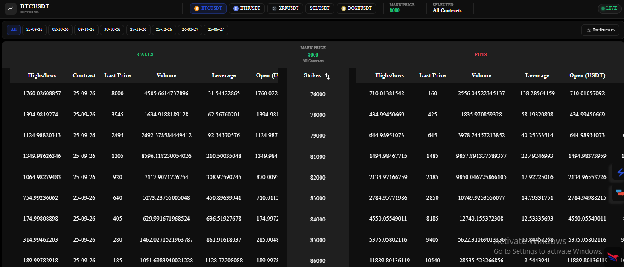
An options trading terminal should make it easy to compare contracts across strikes and expiries while keeping calls and puts clearly separated.
Key Interface Elements
- Underlying Asset / Market Selection — Select the digital asset or market for which options are available.
- Expiry Selection — Choose the contract expiry date or available expiry period.
- Calls & Puts — View call and put contracts side by side for easier comparison.
- Strike Prices — Compare contracts against their respective strike prices.
- Last Price — View the latest available price for each contract.
- Volume — Review trading volume associated with available contracts.
- Contract Information — Access relevant details for each listed option.
- Additional Market Fields — Display leverage or other contract-specific market information where supported.
In-the-Money, At-the-Money & Out-of-the-Money
Options are commonly described as in-the-money (ITM), at-the-money (ATM) or out-of-the-money (OTM) based on the relationship between the underlying price and the strike price.
Options Greeks & Market Information
Options pricing is affected by more than the current price of the underlying. Traders and operators may use option Greeks to understand how an option’s value responds to changes in underlying price, time and volatility.
Wallet, Margin & Position Management
Options positions need an account layer that records the assets and balances associated with trading activity. Exact margin requirements depend on whether a participant is buying or writing options and on the configured risk model.
The HashCash’s exchange wallet infrastructure can provide the account and asset layer around the options product, while the options module handles contract and position context.
Expiry, Exercise & Settlement
Expiry defines when an options contract reaches the end of its specified term. The exchange must apply the exercise and settlement rules associated with each supported contract, ensuring that the position is handled according to its defined terms.
Exercise mechanics depend on the option style. American-style options may allow exercise before expiry, while European-style options are generally exercised at expiry. The settlement process can be configured according to the contract structure and applicable exchange rules, including the relevant settlement price or reference where required.
The platform can track the contract expiry, apply the defined exercise conditions, process the applicable settlement method, and maintain the final position and transaction record after the contract reaches expiry.
API & Exchange Integration
The options module can operate as part of a broader exchange environment, with API management supporting connected applications and exchange services. Controlled API access allows operators to manage which supported functions can be accessed by external applications.
KYC, User Access & Administrative Controls
Options trading operates within the exchange’s broader user and administrative environment. User onboarding, verification, account permissions, transaction management and reporting can remain connected to the options product while being controlled through the platform’s operational layer.
Security for Crypto Options Infrastructure
A crypto options exchange combines trading accounts, market data, APIs, wallets, transactions, and administrative systems. Security should therefore protect both the options module and the wider exchange infrastructure.
- Two-Factor Authentication — Add an additional authentication layer for user and administrative accounts.
- API Access Controls — Manage API permissions and control how connected applications access exchange functions.
- Wallet & Asset Security — Apply security controls to wallet operations and digital-asset management.
- Database Protection — Protect sensitive account, transaction, and platform data stored within the exchange environment.
- Firewall & Network Protection — Secure the underlying infrastructure against unauthorized network access and common network threats.
- Transaction Monitoring — Monitor account and transaction activity to support operational security and visibility.
Options vs Futures Trading
Both are derivatives, but their contract mechanics differ. Futures create an obligation according to the contract, while an option gives the buyer a right without the obligation to exercise. Options also introduce a premium and strike price as core contract variables.
| Trading Function | Futures | Options |
|---|---|---|
| Contract Type | Futures contract | Call or put option |
| Position | Long or short | Buy or write; call or put |
| Strike Price | Not a defining contract variable | Core contract variable |
| Premium | No option premium | Premium paid or received for the option |
| Expiry | Defined by the futures contract | Core part of the option contract |
| Exercise Right | No separate exercise right for the holder | Buyer has the right, but not the obligation, to exercise |
| Risk & Margin | Margin requirements and position exposure | Premium, position exposure, and configured margin/risk rules |
How Crypto Options Fit Into the Exchange
Options should operate as a dedicated derivatives layer within the wider exchange architecture. HashCash’s user-facing options chain connects contract selection and pricing with order execution, liquidity, account balances and settlement, while APIs, KYC, security, reporting and administration support the platform around it.