Crypto Exchange Models
Compare centralized, decentralized and hybrid exchange architectures before choosing the technology, custody, liquidity and operating model behind your platform.What Is a Crypto Exchange Model?
A crypto exchange model defines how users access markets, where trades are executed, how assets are held or authorized, how transactions settle, and how much control the exchange operator has over the platform. The three broad cryptocurrency exchange types are centralized exchanges (CEXs), decentralized exchanges (DEXs), and hybrid exchanges that combine selected centralized and blockchain-native components.
The distinction is architectural, not simply visual. Two platforms can look similar at the interface level while using very different custody, execution, liquidity and settlement systems underneath. Choosing the model early therefore affects wallet infrastructure, matching and market logic, API connectivity, KYC and AML workflows, security controls, reporting, deployment and ongoing operations.
CEX vs DEX vs Hybrid: At a Glance
| Dimension | CEX | DEX | Hybrid |
|---|---|---|---|
| Primary execution | Centralized order book / matching | Smart-contract or protocol-based execution | Combination of centralized and on-chain paths |
| Asset control | Typically platform-managed custody | Users generally retain wallet control | Can vary by market or workflow |
| Settlement | Often exchange-account / ledger based until withdrawal | On-chain | Centralized, on-chain or configured combination |
| Liquidity model | Order books + external liquidity / market makers | Pools, AMMs or other DEX mechanisms | Centralized liquidity + supported on-chain liquidity |
| Operator control | High | More limited at the wallet / protocol layer | Centralized controls coexist with on-chain components |
| Typical fit | Managed trading venue and account-based exchange | Wallet-native, self-custody trading | Businesses needing both exchange and on-chain capabilities |
Centralized Crypto Exchange (CEX)
A centralized crypto exchange places the core trading environment and major operational controls under an exchange operator. Users normally trade through exchange accounts, while order processing, matching, balances, wallets, liquidity connections, administration and reporting are coordinated through centralized services.
This model is often appropriate when the business needs a conventional trading venue with account management, defined markets, operator oversight, integrated liquidity and a controlled operational environment. A CEX architecture can also connect to fiat-payment services, KYC and AML providers, external APIs, market data and specialist custody or wallet infrastructure.
Decentralized Crypto Exchange (DEX)
A decentralized crypto exchange changes the relationship between the user, wallet and trading infrastructure. Instead of requiring users to place assets into a conventional custodial exchange account, a DEX can connect compatible wallets to blockchain-based trading logic, allowing supported transactions to be authorized from the user's wallet environment.
The technical architecture can include wallet connectivity, smart-contract execution, on-chain settlement, liquidity pools or other decentralized-market mechanisms, blockchain infrastructure and a platform layer for supported assets, interfaces, analytics and administration. DEX designs vary considerably, so the exact execution and liquidity mechanism should be evaluated against the selected protocol and network.
Hybrid Crypto Exchange
A hybrid crypto exchange combines selected centralized exchange infrastructure with decentralized or on-chain components. The exact balance can vary: centralized services may handle account management, order processing, administration and selected markets, while wallet-connected or blockchain-based components can support other workflows.
The advantage of the hybrid model is architectural flexibility rather than a universal promise of lower cost, higher speed or greater security. A hybrid deployment needs clear boundaries between centralized services and blockchain-facing components, including where assets are held, where execution occurs, how transactions are signed, how liquidity is supplied and how records are reconciled.
How the Exchange Model Changes the Technology Stack
Selecting a model should not happen independently of the rest of the exchange architecture. HashCash's model determines which infrastructure layers become central to the product and how those layers interact.
The Operational Layers Still Matter
Choosing CEX, DEX or hybrid does not remove the need for operational infrastructure. HashCash's exchange still needs ways to manage users, transactions, reporting, fees, security and access according to its architecture.
- Admin Panel — Centralized operator controls for users, settings, transactions, wallets, fees and exchange activity.
- Transaction Management — Track transaction lifecycle, status, records and operational review across supported workflows.
- Reporting & Analytics — Give operators visibility into trading, transactions, users and operational activity.
- Fee & Trading Management — Configure fees, commissions, markets, order settings and related trading controls.
- Infrastructure Security — Align cloud, network, access, monitoring and infrastructure controls with the selected model.
- Hardware Wallet Security — Use hardware-backed signing and multi-signature controls where the custody architecture supports them.
A Model Decision Becomes an Operating Platform
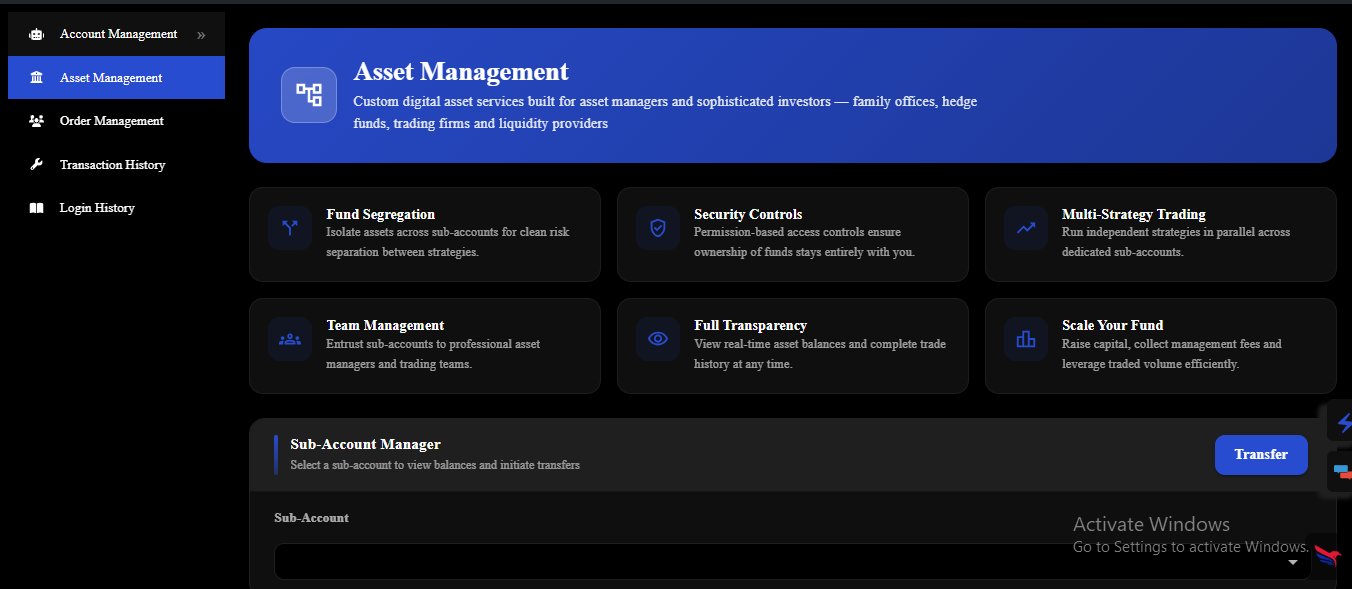
The exchange model is ultimately expressed through the platform's account, asset and operational layers.
Which Crypto Exchange Model Fits Your Business?
There is no universal best exchange model. The better question is which architecture matches the intended users, asset-control model, trading experience, liquidity strategy, operational responsibilities and deployment requirements.
- Choose a centralized model when the business needs account-based trading, operator-managed exchange services, integrated liquidity, defined markets and centralized administration.
- Choose a decentralized model when wallet-connected trading, user-controlled transaction authorization and blockchain-native execution are core requirements.
- Consider a hybrid model when the product needs centralized exchange services alongside selected wallet, smart-contract, decentralized liquidity or on-chain workflows.
- Define custody separately from the interface. A branded front end does not by itself determine who controls assets or how transactions are authorized.
- Evaluate liquidity before launch. The market model, liquidity source, execution method and supported pairs need to work together.
- Map compliance and operational responsibilities to the actual deployment and target markets rather than assuming one workflow applies to every exchange model.
Exchange Model Selection Checklist
Exchange Models and the Wider HashCash Architecture
HashCash can structure exchange deployment as a connected architecture rather than a standalone trading interface. A selected model can be combined with the required matching, liquidity, wallet, API, market-data, transaction, reporting, administration, security and partner layers according to the business requirements.
For a white label crypto exchange, this allows the branded customer experience to sit on top of a configured technology stack while the underlying architecture remains aligned with the selected exchange model.
Trading Products Can Sit Above the Core Exchange Model
The CEX, DEX or hybrid decision establishes the underlying architecture, but the trading products offered through that architecture are a separate design layer. HashCash's exchange structure can be extended around the selected trading requirements, subject to the relevant implementation.
Deployment and Ownership Questions
Before selecting a model, an operator should also define how the exchange will be deployed and maintained. Cloud versus on-premises deployment, software and intellectual-property rights, data ownership, custom assets and trading contracts, engagement model and mobile access can all affect the final architecture.
- Hosting: On-Premises vs Cloud — Choose the infrastructure environment around operational, security and deployment requirements.
- Intellectual Property — Clarify software, licensing, customization and technology-rights considerations.
- Exchange Data Ownership — Define access, responsibility and operational handling of exchange data.
- Custom Crypto Assets & Trading Contracts — Define asset, token and supported trading-contract requirements.
- Engagement Model — Plan requirements, configuration, integrations, testing, deployment and support.
- Mobile App Setup — Extend the selected exchange model into branded mobile trading and account experiences.
Why HashCash for Crypto Exchange Model Selection?
HashCash can structure a crypto exchange around the model the business actually intends to operate. The focus is not only on the customer-facing interface, but on connecting the selected exchange model with trading infrastructure, wallets, liquidity, APIs, market data, operations, security, partner services and deployment requirements.