Crypto Asset Management Platform
Separate funds, manage strategies, control team access and monitor asset activity from one centralized environment.Explore how HashCash can configure an asset management platform around your operational model.
Asset Management Built Around Your Fund Structure
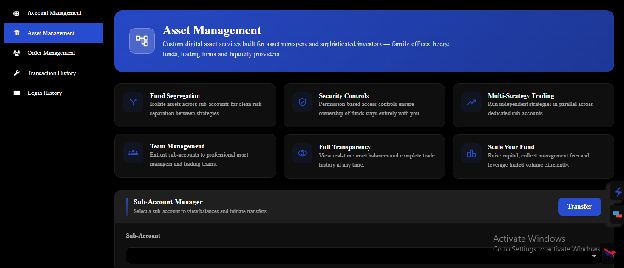
Digital-asset businesses rarely operate as a single account with a single strategy. Different funds, clients, strategies or trading teams may require separate operational boundaries. HashCash brings that structure into the asset-management environment through dedicated sub-accounts and controlled workflows.
Instead of treating every balance and transaction as part of one large pool, the platform can organize assets around the structures your business uses to manage them.
Fund Segregation Across Dedicated Sub-Accounts
Fund segregation gives professional operators a clearer way to separate assets across sub-accounts. Each sub-account can represent a distinct strategy, fund, trading activity or operational requirement, depending on the deployment.
| Use of segregation | Operational benefit |
|---|---|
| Separate strategies | Keep assets and activity associated with independent strategies. |
| Separate funds | Create clearer boundaries between managed pools of assets. |
| Separate trading teams | Give teams dedicated operating scopes. |
| Separate account activity | Make portfolio review and transaction visibility easier to organize. |
| Controlled transfers | Move assets between supported account structures through the available transfer workflow. |
This structure is particularly useful when an asset-management operation needs to grow beyond one portfolio while retaining clear organizational boundaries.
Multi-Strategy Trading Without Mixing Operational Scope
Different strategies can require different portfolios, trading rules and capital allocations. HashCash's asset-management interface presents multi-strategy trading around dedicated sub-accounts, allowing independent strategies to operate in parallel without forcing every activity into a single account.
Strategy A
Strategy B
Security Controls Through Permission-Based Access
Asset management is also a people-management problem. Portfolio information, balances, transfers and trading activity should not necessarily be visible or actionable to every user. HashCash's interface identifies permission-based security controls as a way to keep ownership of funds and operational responsibilities within the appropriate user scope.
Define User Access by Responsibility
Assign permissions according to each user's role and operational responsibilities.
Align Ownership With Account Structure
Keep fund ownership and operational authority within the appropriate account scope.
Enable Controlled Team Collaboration
Allow asset managers and trading teams to work within clearly defined access boundaries.
Strengthen Operational Governance
Use permission controls as part of the broader framework for managing asset access and responsibilities.
Team Management for Professional Asset Operations
Professional asset management involves more than one decision-maker. Asset managers, traders, operations teams and other authorized users may work around the same fund structure. HashCash's Team Management capability should therefore be presented as an operational collaboration layer, not as a generic “user management” feature.
| Team requirement | Understandability |
|---|---|
| Shared operational environment | Teams can work around the same managed-asset structure. |
| Controlled access | Users receive access according to their assigned responsibilities. |
| Strategy collaboration | Trading teams can operate within dedicated strategy structures. |
| Operational visibility | Authorized users can review balances and activity relevant to their scope. |
Full Transparency Across Balances and Trading Activity
Asset managers need to know what is held, where it is held and what activity has taken place. The supplied interface explicitly highlights real-time asset-balance visibility and complete trade-history access.
Asset Balances
Account Activity
Trade History
Operational Review
Scale Your Fund With Better Operational Structure
Growth introduces operational complexity. More capital, more strategies, more trading activity and more management responsibilities can make a single-account structure increasingly difficult to administer. HashCash's asset-management interface positions Scale Your Fund around raising capital, collecting management fees and handling traded volume.
Sub-Account Management: The Operational Control Center
The Sub-Account Manager should receive its own major section because it connects several of the platform's visible capabilities. An operator can select a sub-account, view balances and initiate transfers, creating a direct workflow for managing assets across the fund structure.
| Sub-account workflow | What the interface communicates |
|---|---|
| Select | Choose the sub-account that requires attention. |
| View | Review the relevant balance information. |
| Transfer | Initiate a supported transfer from the management interface. |
| Separate | Maintain the organizational structure between account scopes. |
| Monitor | Use activity and trade-history visibility for operational review. |
Digital Asset Management Software for Structured Operations
Digital asset management software should do more than display a combined wallet balance. For professional users, the value lies in organizing assets around portfolios, accounts and strategies while giving authorized teams the visibility and controls needed to operate them.
HashCash's approach adds that operational layer through fund segregation, sub-account management, multi-strategy trading, permission-based access, team management and transparent activity visibility.
Crypto Asset Management for Different Professional Users
| Audience | Relevant platform capability |
|---|---|
| Asset managers | Fund segregation, portfolio visibility, strategy organization and team controls. |
| Hedge funds | Dedicated strategy accounts, trading visibility and controlled access. |
| Trading firms | Multi-strategy trading, team management and operational transparency. |
| Family offices | Structured digital-asset portfolios, account separation and visibility. |
| Liquidity providers | Account organization, trading activity and operational control. |
| Digital-asset businesses | A management layer that can connect with broader exchange and wallet infrastructure. |
Connect Asset Management With the Wider Digital-Asset Stack
Asset management becomes more useful when it connects with the infrastructure that holds, moves, trades and reports digital assets. HashCash's wider ecosystem includes exchange, wallet, liquidity, transaction-management, reporting and API capabilities, allowing asset management to be positioned as part of a broader digital-asset operating environment.
This architecture lets the asset-management layer remain focused on portfolio structure, strategy and operational oversight while connected systems handle the underlying exchange and asset workflows.